Greetings, friends.Finally, warm days have come, the snow is melting rapidly.In this article I want to share with you what you need to do with peonies in the spring so that they please you with lush, bright blooms and large flowers.

Many gardeners grow herbaceous peonies, not so long ago ITO peonies appeared, this is the result of crossing tree and herbaceous peonies. Spring care for peonies. 1. After the snow has melted, remove all plant debris and weeds, clean old foliage around the peony and mulch, if any.
Grass peonies do not cover, but tree peonies in cold climates sometimes need shelter. 2. Very carefully loosen the soil at some distance from the bush if the soil is very dense, so we will provide the plant with oxygen access. 3. If the spring is dry, the bushes need to be watered, I pour 1 bucket of water on 1 bush, but not immediately, but let it soak in. 4. Fertilizing, which must be applied for growth and lush flowering. For feeding a peony, elements such as phosphorus (for root development), potassium (for flowering and color brightness) are important, and for the growth of green mass, the peony needs nitrogen, there should be more of it.
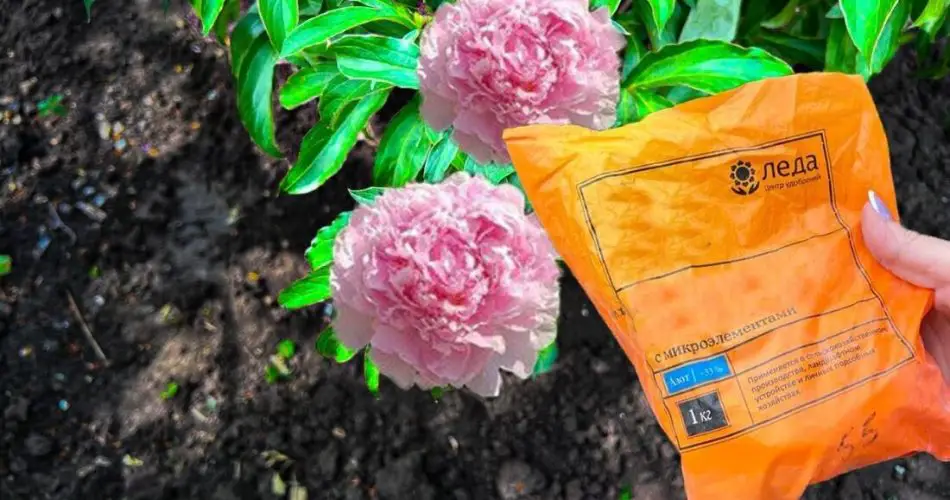
Prepare the fertilizer – 1 tablespoon of nitroammophoska + 0.5 tablespoon of ammonium nitrate per 10 liters of water. I used nitroammophoska with the formula NPK 16 16 16 nitrogen, phosphorus, potassium, and so that there was a little more nitrogen, I added half a spoon of ammonium nitrate.
We mix everything and water a little at the root so as not to expose the roots, but you need to pour a bucket of fertilizer on 1 bush.
After all the moisture is absorbed, I make sure to mulch the bush with dry humus, and we get a double effect, namely humus as mulch and as fertilizer. I’ll tell you what else you can feed peonies in the spring. I take 100 grams of nitrofoska and distribute it evenly along the furrow, and I add rotted manure there and work it into the soil.
As for watering, look at your land, if it is wet, there is no point in watering, if it is dry, then pour it directly into the groove where we applied the fertilizer. In early April, you can apply fertilizers in dry form, such as urea, you need 20 grams per bush, it is more convenient to carry the same into the grooves, embed it in the ground, then water it, and preferably from a watering can with a shower, so as not to erode the soil and not expose the roots. Treatment of diseases For lush flowering, not only fertilizing is important, but also protection from diseases.More often in the spring the plant is affected, for example, by gray rot, etc. Hom, or the same 1% Bordeaux liquid. The second fertilizer for flowering This fertilizer is applied during the formation of buds.At this time nitrogen is needed not so much, as phosphorus and potassium.Here you can use the good old ash, for 10 liters of water I add 1 liter glass of ash, mix, let it stand for a while and water the peonies.
Ash also copes well with soil acidification and can be acidified by applying mineral fertilizers. If there is no ash, add 20 grams of superphosphate + 10 grams of urea + 15 grams of potassium sulfate per 10 liters of water. Dissolve all this and pour it over the peonies. Watering is very important for them, because after the peony flowering ends, it begins to lay new buds for the next year.
Without fertilization, such a beautiful flowering can hardly be achieved, if fertilizers are not applied, the soil becomes poor and the bushes do not give beautiful and lush flowering. That’s all I wanted to share with you, you can also share your tips and photos in the comments.