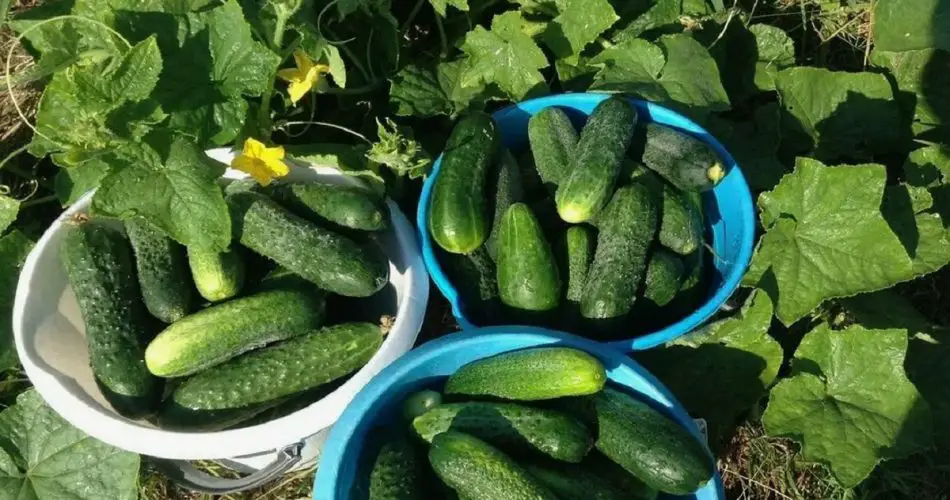
I grew cucumbers and did not know how to make them juicy and not curled. And 3 years ago I was told that I was doing everything wrong. Because of this, I also have no harvest. It turns out that there are secrets of rationing, without which the harvest will not be visible. And I will also tell you what to do with hollow flowers so as not to waste time. And at the end there will be all the tricks of feeding.
So that the cucumbers are always juicy and sweet
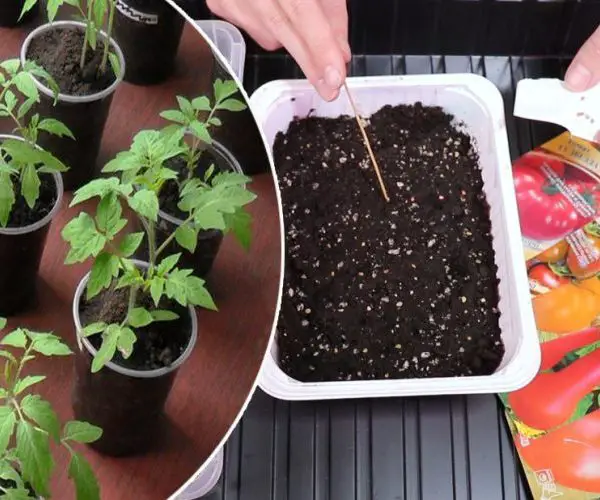
Do you sow varietal seeds, and the cucumbers grow crooked and tough? The thing is that it is not enough to plant high-quality seedlings. It is important to create all the conditions for capricious cucumbers for abundant fruiting. More on that later.
1. Cucumber loves heat very much and does not grow if the air temperature is below +18 degrees. But the most suitable temperature for fruit formation is +25 degrees, no more and no less. Cucumber also suffers from the spiciness.
The seedlings are planted in the ground when the soil warms up to +13 … +15 degrees. In cold beds, cucumbers simply rot. At the slightest cold snap, cover the plantings or keep them in a greenhouse if the weather in your region deteriorates sharply.
2. In the spring, when planting in the ground, the soil must be mulched: straw, sawdust and humus. Apply a thick layer of mulch, up to 10 cm, you will not regret it. Mulch protects the root from the night cold, and during the day it retains moisture in the soil and prevents weeds from forming between plantings.
3. At high temperatures, cucumbers need to be watered 3-5 times a week. The higher the air temperature, the more often and more abundantly watered. Cucumbers love water, because they are 90% water. The more often they are watered, the juicier the fruits will be.
4. Water only with settled water. If you have a well on your site, especially a deep one, the water from it will be cold. Watering with cold water will cause a temperature shock to the plant, it will develop worse and may even get sick. It is best to put a special barrel on the site, which will be filled with rain or from a well.
5. Gardeners rejoice when they see the first bud, but it must be ruthlessly torn off in order to stimulate the growth of many ovaries. If this is not done, there will be fruits, but in smaller quantities.
6. Why does a cucumber sometimes produce solid hollow flowers, although it has almost no ovaries? The main reason for this phenomenon is hypothermia. Either you planted the cucumber too early, or the weather played a role, but the plant froze and produced most of the male type flowers.
In this situation, varieties and hybrids-parthenocarpics, which initially bloom according to the female type and give many ovaries, are saved.
In the greenhouse, you can add fertilizers to the soil, increase the mulch layer and increase the temperature with heaters. But what to do with hollow flowers?
How to properly feed cucumbers when planting
The cucumber develops gradually and it is very important to feed it correctly at all stages of development. By the way, proper feeding solves the problem of fruit curling. I feed my cucumbers according to a special scheme. It consists of 4 important stages – if you miss one, you can forget about the harvest.
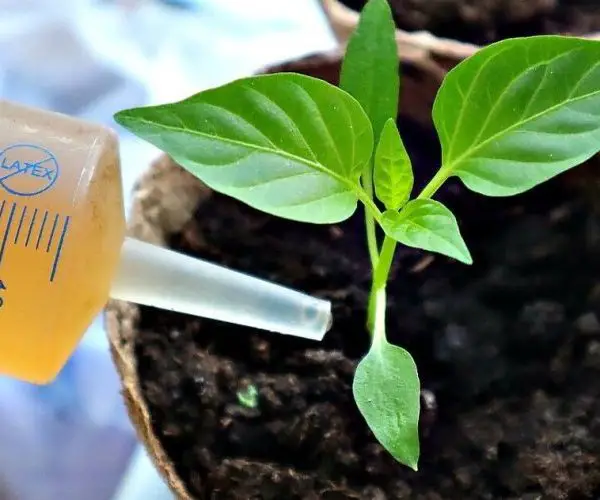
1. 12-14 days after seed germination, the first feeding of the seedlings is carried out. This procedure allows for a quick start of the growth of the roots and the above-ground part.
2. As soon as the cucumber begins to bloom and form ovaries, feed a second time. Here you can give both root and foliar feeding – directly on the leaf.
3. Once fruiting has begun, feed every 8 to 12 days.
4. To extend the “harvest time” and encourage the cucumber to the second wave of flowering, fertilizers are applied every 5 days.
And I will tell you one by one which fertilizers are best suited for cucumbers.
Feeding to make cucumbers grow juicy and sweet
When first feeding seedlings, cucumbers need organic matter with a high nitrogen content to build powerful green lashes and roots. To strengthen the root and stems, you need calcium in an easily digestible form.
Therefore, humus, diluted manure, “green” fertilizer from weeds, as well as calcium nitrate are applied. Ammonium nitrate in a highly diluted form is also suitable. Remember that the roots of seedlings are sensitive, so make Parole in small portions and only after watering.
Mullein or chicken manure is diluted in a ratio of 1:10 and the seedlings are watered abundantly directly under the root. Natural organic matter is not suitable for foliar fertilization – you understand why.
I dilute calcium nitrate as follows: I take 10 g of fertilizer per 10 liters of water. This is for feeding under the root when watering. If you want to spray on the leaf, then take 20 g per 10 liters of water.
During the flowering period, the cucumber needs a wide variety of trace elements, so I increase the number of feedings. I use superphosphate, nitroammophoska, potassium sulfate and be sure to spray it with boron.
When the cucumbers are already growing, the plant needs vital nitrogen and potassium. Here, too, I use organic material: mullein, chicken manure, “green” fertilizer, humus, humus – whatever is at hand. And I also add potassium monophosphate.
To prolong fruiting, a solution of mullein and ordinary wood ash with the addition of potassium and phosphorus is used. I mix everything in a complex and water under the root strictly 1 time every 5 – 7 days.
And as for a technique like “rationing,” it’s just tearing off excess ovaries if there are suddenly too many of them and you don’t want the cucumbers to grow very small.